Solar for Factories in Patiala: Cost, Savings & ROI Guide
Electricity is one of the major operating expenses for many manufacturing and industrial businesses.
Factories may use electricity for machinery, motors, compressors, lighting, ventilation, cooling systems, pumps and other production equipment. For businesses with substantial electricity consumption, rising energy expenses can directly affect operating costs and profitability.
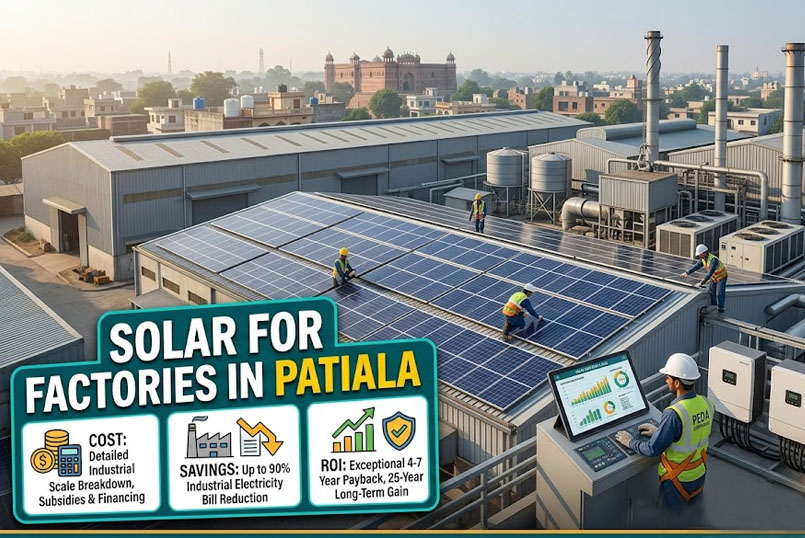
This makes solar for factories in Patiala an increasingly important option for businesses looking to reduce electricity expenses and improve long-term energy management.
A properly designed industrial rooftop solar system can help a factory generate electricity from its available roof space and reduce its dependence on grid electricity.
In this guide, we explain how factory owners can evaluate solar, what affects the cost, how savings work and what to consider before choosing an industrial solar installer.
Why Should Factories in Patiala Consider Solar?
Factories often have something that makes rooftop solar particularly attractive: high electricity consumption.
Industrial facilities may operate equipment such as:
- Motors
- Pumps
- Compressors
- CNC machines
- Production machinery
- Air-conditioning systems
- Ventilation systems
- Lighting
- Refrigeration
- Office equipment
- Material-handling equipment
Many factories also operate during daylight hours, when rooftop solar is generating electricity.
This creates an opportunity to use a significant portion of the generated solar power within the facility.
Major benefits can include:
- Reduced electricity expenses
- Better control over energy costs
- Productive use of unused rooftop space
- Reduced dependence on grid electricity
- Long-term energy savings
- Improved sustainability
- Potentially attractive return on investment
The actual financial benefit depends on the factory’s consumption profile, system size, applicable electricity tariff and regulatory arrangement.
How Much Solar Does a Factory Need?
There is no standard solar capacity for every factory.
A factory might need a system of 20kW, 50kW, 100kW, 250kW or significantly more depending on its electricity requirements.
The right capacity should be determined after analysing:
- Electricity bills
- Monthly units consumed
- Sanctioned load
- Contract demand, where applicable
- Daytime electricity consumption
- Factory operating hours
- Available rooftop area
- Roof structure
- Future expansion plans
Don’t choose the system size based only on roof area.
A large roof does not automatically mean that the factory should install the largest possible solar system.
The objective should be to design a system that makes technical and financial sense for the business.
What Is the Cost of Solar for a Factory?
The cost of an industrial solar installation varies significantly from project to project.
Important cost factors include:
Solar panels
Panel capacity, technology, manufacturer and warranty can influence the project cost.
Inverters
Industrial installations may require one or more appropriately sized inverters depending on system architecture.
Mounting structure
The structure must be suitable for the factory roof and local environmental conditions.
Electrical equipment
The project may require:
- DC cables
- AC cables
- Distribution equipment
- Protection devices
- Earthing
- Lightning protection
- Monitoring equipment
Installation
Labour and installation costs depend on project size and complexity.
Electrical modifications
Some factories may require modifications to existing electrical infrastructure before the solar system can be integrated.
Roof conditions
The type, height and accessibility of the roof can influence installation requirements.
Utility requirements
Applicable approvals, metering arrangements and electrical requirements can also affect the overall project.
For this reason, factory owners should request a detailed site-specific quotation instead of relying on a generic per-kW price.
How Much Can a Factory Save With Solar?
Solar savings depend primarily on how much electricity the system generates and how that electricity is used.
Factors include:
- Solar capacity
- Solar irradiation
- Panel orientation
- Shading
- System efficiency
- Factory electricity consumption
- Daytime load
- Electricity tariff
- Applicable billing/export arrangement
- System maintenance
A factory with significant daytime electricity consumption may be able to use a large portion of its solar generation directly.
This can reduce the amount of electricity it needs to purchase from the grid.
Why Daytime Load Is Important for Industrial Solar
Consider a factory operating from:
9:00 AM to 6:00 PM
During these hours, the factory may run:
- Production machines
- Motors
- Compressors
- Pumps
- Lighting
- Ventilation
- Office systems
At the same time, the solar system is producing electricity.
This can create a strong match between solar generation and electricity consumption.
Factories with high daytime loads should therefore analyse their load profile before deciding on system capacity.
On-Grid vs Hybrid Solar for Factories
One of the first decisions is whether the factory needs an on-grid or hybrid system.
On-Grid Solar
An on-grid system works alongside the electricity grid.
It is generally considered when the primary objective is:
Reducing electricity costs.
Advantages may include:
- Lower initial cost than a comparable battery-based system
- No large battery bank
- Good fit for daytime electricity consumption
- Easier scalability in suitable applications
However, a standard on-grid solar system generally does not provide backup electricity when the grid is unavailable.
Hybrid Solar
A hybrid system combines solar with battery storage and grid power.
It may be considered when a factory requires backup for selected loads.
Possible backup loads can include:
- Security systems
- Emergency lighting
- Computers
- Communication equipment
- Control systems
- Selected machinery
However, battery storage can significantly increase the initial project cost.
Factories should therefore determine which loads genuinely require backup rather than automatically installing batteries for the entire facility.
Can Solar Power Run Factory Machinery?
Yes, solar-generated electricity can contribute to the electricity requirements of a factory, but the system must be properly designed around the facility’s electrical infrastructure.
Industrial installations require careful consideration of:
- Load characteristics
- Motor loads
- Starting currents
- Power factor
- Voltage levels
- Transformer arrangements
- Inverter capacity
- Protection systems
- Electrical safety
A professional industrial solar installer should evaluate the factory’s electrical system before finalising the design.
What Roof Is Suitable for Factory Solar?
Factory buildings often have large roofs, making them potentially suitable for rooftop solar.
However, the roof needs to be assessed before installation.
Important factors include:
Roof strength
The structure should be able to safely support the proposed mounting system.
Roof condition
Damaged or aging roofs may require repair before solar installation.
Shading
Water tanks, nearby buildings, equipment and other structures can affect solar generation.
Orientation
Roof orientation and panel positioning affect energy production.
Access
There should be safe access for installation and future maintenance.
Drainage
The mounting design should not interfere with existing roof drainage.
Can a Factory Install Solar on a Large Rooftop?
Yes, large industrial rooftops can potentially support substantial solar installations.
However, the maximum practical system size depends on several factors.
These include:
- Electricity consumption
- Sanctioned load
- Electrical infrastructure
- Rooftop area
- Applicable regulations
- Metering arrangement
- Utility requirements
- Project economics
The system should therefore be designed around the factory’s actual electricity requirements rather than simply filling the entire roof with panels.
Is Government Subsidy Available for Factory Solar?
Factory owners should be careful when evaluating subsidy claims.
The central PM Surya Ghar: Muft Bijli Yojana rooftop-solar financial assistance is intended for eligible residential consumers.
Therefore, a factory using a commercial or industrial electricity connection should not assume that the residential PM Surya Ghar subsidy applies.
Commercial and industrial solar projects should instead be evaluated based on their actual project economics, applicable electricity arrangements and current regulations.
Because policies and electricity regulations can change, businesses should verify the latest applicable rules before finalising a project.
What Is the ROI of Industrial Solar?
Return on investment depends on:
- Total project cost
- Solar generation
- Electricity tariff
- Self-consumption
- Export treatment
- Financing cost
- Maintenance expenses
- System performance
A simple way to understand the concept is:
Annual Solar Benefit ÷ Total Solar Investment = Approximate Annual Return
However, a professional feasibility study should account for degradation, maintenance, tariff changes, financing and other project-specific factors.
A quotation that promises a fixed payback period without analysing the factory’s electricity consumption should be treated carefully.
How to Calculate Solar Requirements for Your Factory
Before contacting a solar company, collect:
1. Electricity bills
Ideally, keep at least 6–12 months of bills.
2. Load information
Provide details of sanctioned load and contract demand where applicable.
3. Operating schedule
Mention:
- Working hours
- Number of shifts
- Weekday/weekend operation
4. Equipment information
List major electricity-consuming machinery.
5. Roof information
Provide the approximate available roof area and any known structural information.
6. Future plans
If the factory plans to expand production, tell the installer before the system is designed.
This information helps the installer recommend a more realistic system.
How to Choose an Industrial Solar Company in Patiala
Industrial solar is more complex than installing a few panels on a small residential roof.
When comparing solar companies, check:
Experience
Ask whether the company has experience with commercial or industrial installations.
Equipment
Check the proposed panel, inverter and protection equipment specifications.
Engineering
The company should provide proper system design rather than only a basic quotation.
Installation
Ask about mounting structure, cable routing, earthing and electrical protection.
Monitoring
A good monitoring system can help identify performance issues.
Warranty
Understand both manufacturer warranties and installation workmanship coverage.
After-sales service
Ask who will handle maintenance and troubleshooting after commissioning.
Why Factory Owners Should Compare More Than the Lowest Price
A cheaper quotation may not always result in the lowest lifetime cost.
Important things to compare include:
- Panel efficiency
- Inverter quality
- Structure quality
- Cable specifications
- Protection equipment
- Engineering standards
- Installation workmanship
- Monitoring
- Warranty
- Service support
For an industrial installation, reliability can be just as important as the initial project price.
Solar Maintenance for Factories
Solar panels generally require relatively low routine maintenance, but industrial systems should still be monitored regularly.
Maintenance can include:
- Panel cleaning
- Visual inspection
- Cable inspection
- Structure inspection
- Inverter monitoring
- Earthing checks
- Electrical protection checks
- Performance monitoring
Factories located in dusty industrial environments may need more frequent panel cleaning.
Regular monitoring can also help identify underperformance early.
Why Solar Can Be a Long-Term Energy Strategy for Factories
A factory’s electricity demand can remain significant for many years.
Instead of treating electricity only as a monthly operating expense, businesses can consider solar as a long-term energy investment.
A well-designed system can help the business:
- Generate part of its own electricity
- Reduce grid electricity purchases
- Use unused rooftop space
- Improve energy planning
- Reduce exposure to future electricity-cost increases
The exact financial outcome will depend on the factory’s individual circumstances.
Why Choose A.P. Tech Solar for Factory Solar?
Planning industrial solar installation in Patiala requires more than selecting panels and an inverter.
A.P. Tech Solar can help businesses evaluate:
- Electricity consumption
- Rooftop suitability
- Solar capacity
- Equipment requirements
- Electrical integration
- Installation requirements
- Monitoring
- Long-term system performance
The goal should be to develop a solar solution based on the factory’s actual electricity consumption and business requirements.
Planning solar for your factory in Patiala? Contact A.P. Tech Solar for a site assessment and customised commercial solar quotation.
Frequently Asked Questions
Is solar suitable for factories in Patiala?
Yes. Factories with significant electricity consumption and suitable rooftop space can consider solar to reduce grid electricity purchases.
How much solar does a factory need?
The required capacity depends on electricity consumption, daytime load, operating hours, rooftop area, electrical infrastructure and applicable regulations.
Can solar reduce a factory’s electricity bill?
Yes. A properly sized system can reduce electricity purchased from the grid, although the actual savings depend on system generation and the factory’s electricity usage.
Does a factory need batteries?
Not necessarily. An on-grid system may be suitable when the primary objective is electricity-cost reduction. Batteries are more appropriate when backup power is required.
Can solar power industrial machinery?
Solar can contribute to a factory’s electricity requirements, but the system must be engineered around industrial loads, electrical infrastructure and equipment characteristics.
Can factories get residential solar subsidy?
Factories should not assume that residential rooftop-solar subsidy schemes apply to industrial or commercial electricity connections. Eligibility depends on the applicable programme and consumer category.
How much roof space does a factory need for solar?
The required area depends on system capacity, panel wattage, mounting arrangement and spacing. A professional site survey should determine the usable area.
How do I get a solar quotation for my factory in Patiala?
Provide your recent electricity bills, operating schedule and basic roof information to a professional installer. A site survey can then be used to prepare a customised proposal.