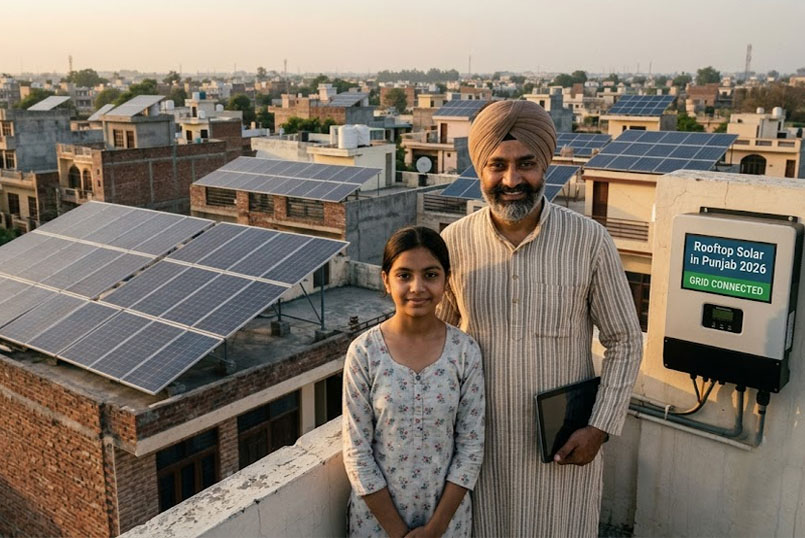
Rooftop Solar in Punjab 2026: Latest Subsidy, Net Metering Rules, Cost & Savings
Rooftop solar is becoming an increasingly practical option for homes and businesses across Punjab. In 2026, the combination of government support, rising interest in electricity-bill savings and updated rooftop-solar regulations is making solar power an important investment for Punjab property owners.
The PM Surya Ghar: Muft Bijli Yojana has accelerated residential rooftop solar adoption across India, while Punjab has continued updating its own rooftop-solar framework and procedures.
If you are considering installing solar panels in Patiala, Mohali, Chandigarh, Ludhiana, Kharar, Rajpura, Sangrur or another part of Punjab, understanding the latest rules, subsidy and system costs can help you choose the right system.
What Is Rooftop Solar?
A rooftop solar system uses photovoltaic (PV) panels installed on a home’s, commercial building’s or industrial property’s roof to generate electricity from sunlight.
A typical grid-connected rooftop solar system consists of:
- Solar PV panels
- Solar inverter
- Mounting structure
- DC and AC protection equipment
- Wiring and electrical components
- Bi-directional/net meter where applicable
During the day, the solar system supplies electricity to the property. Depending on the system and applicable regulations, surplus electricity can be exported to the grid.
What Has Changed for Rooftop Solar in Punjab in 2026?
Punjab’s rooftop-solar regulations have evolved, giving consumers more options for using solar-generated electricity.
According to the Punjab Energy Development Agency (PEDA), rooftop solar systems in Punjab can operate under arrangements including net metering, net billing, group net metering, gross metering, virtual net metering and behind-the-meter arrangements.
The regulations were also amended in April 2026.
For many residential consumers, the most important consideration remains how much electricity the solar system can generate and how much of that electricity can be used or adjusted against grid consumption.
PM Surya Ghar Subsidy for Rooftop Solar
The PM Surya Ghar: Muft Bijli Yojana provides central financial assistance for eligible residential rooftop solar systems.
Under the scheme, the commonly applicable central assistance structure provides:
| Solar System Capacity | Central Subsidy |
|---|---|
| 1 kW | ₹30,000 |
| 2 kW | ₹60,000 |
| 3 kW and above | ₹78,000 maximum |
The subsidy is capped at the applicable 3 kW level for the central residential subsidy structure.
In July 2026, the government also announced measures aimed at making rooftop solar more affordable, including higher central financial assistance for the first 2 kW and access to collateral-free loans through nationalized banks at concessional rates.
Who Can Benefit?
Residential electricity consumers with an eligible grid-connected electricity connection can apply through the PM Surya Ghar national process.
Consumers should check their current eligibility, DISCOM requirements and approved-vendor requirements before proceeding.
How Much Does a Rooftop Solar System Cost in Punjab?
The final price of a solar system depends on several factors, including:
- System capacity
- Solar panel technology
- Inverter brand and capacity
- Mounting structure
- Roof type
- Installation complexity
- Electrical work
- Net-metering requirements
- Warranty and after-sales support
Instead of selecting a system purely based on the lowest installation price, homeowners should compare the complete system cost, expected generation, warranties, equipment quality and long-term savings.
Indicative System Sizes
A homeowner may commonly consider:
3 kW solar system
Suitable for a household with moderate electricity consumption. It is also particularly relevant because the central subsidy structure reaches its maximum at 3 kW.
5 kW solar system
A suitable option for homes with higher electricity consumption or properties with larger daytime loads.
10 kW solar system
Can be considered for larger homes, commercial properties and other applications where electricity consumption is substantially higher.
The right capacity should be calculated from the property’s electricity consumption rather than selected simply because a particular system size is popular.
How Does Net Metering Work in Punjab?
With a grid-connected solar system, electricity generated by the panels is first used by the property.
If the solar system produces more electricity than the property is consuming at that moment, surplus electricity may be exported to the grid according to the applicable arrangement.
When the property requires more electricity than the solar system is producing, electricity can be imported from the grid.
PEDA states that rooftop solar systems in Punjab can use different regulatory arrangements, including net metering and net billing.
For consumers considering a system, the applicable arrangement should be confirmed before installation because the financial outcome depends on the relevant rules and tariff structure.
What Is the 2026 Feed-in Tariff for Net Billing and Gross Metering in Punjab?
For FY 2026–27, PSPCL issued a commercial circular stating a ₹2.97/kWh feed-in tariff for net billing and gross metering arrangements under the applicable PSERC rooftop-solar regulations. The tariff applies from April 1, 2026, to March 31, 2027.
This is an important distinction for consumers because the financial treatment of exported electricity can differ depending on the arrangement used.
Is Rooftop Solar Worth It in Punjab in 2026?
For many properties, rooftop solar can make financial sense because it can reduce dependence on electricity purchased from the grid.
The potential benefits include:
- Lower electricity bills
- Greater energy independence
- Reduced exposure to future electricity-price increases
- Government subsidy for eligible residential installations
- Long-term electricity generation
- Reduced carbon emissions
- Increased use of renewable energy
However, the actual savings depend on the property’s electricity consumption, system size, solar generation, tariff, roof orientation, shading and applicable electricity regulations.
How Much Electricity Can Solar Panels Generate?
Solar generation varies throughout the year.
Factors affecting generation include:
- Solar panel capacity
- Roof orientation
- Tilt angle
- Shading
- Weather
- Dust and dirt
- Temperature
- Inverter efficiency
- System maintenance
Punjab receives substantial sunlight during much of the year, making rooftop solar a practical option for many residential and commercial properties.
A professional solar assessment should be performed before finalizing system capacity.
Should You Choose 3 kW or 5 kW Solar in Punjab?
The answer depends primarily on your electricity consumption.
A 3 kW system may be appropriate for a household with moderate electricity consumption and can be particularly attractive where the homeowner wants to take advantage of the maximum central residential subsidy.
A 5 kW system may be more appropriate where electricity consumption is higher, particularly when the property has significant daytime usage.
For example, households using multiple air conditioners, water pumps, refrigerators and other high-consumption appliances may require a larger system.
The best approach is to review at least the previous 12 months of electricity bills before deciding.
What Documents Are Generally Needed?
Depending on the application and DISCOM process, consumers may need information such as:
- Electricity connection details
- Consumer account information
- Property/roof details
- Bank account information for subsidy processing
- Identity and address information
- Required declarations or agreements
Requirements can change, so applicants should confirm the latest requirements through the relevant official portal or DISCOM.
How to Choose a Solar Installation Company in Punjab
Choosing the right installer is just as important as choosing solar panels.
Before selecting a solar company, ask about:
1. Experience
Look for an installer with experience in residential, commercial or industrial projects similar to yours.
2. Solar Equipment
Ask which solar panel and inverter manufacturers will be used and whether the equipment meets the applicable requirements.
3. Installation Quality
A good solar system depends not only on the panels but also on proper mounting, wiring, protection and installation practices.
4. Warranty
Understand the product warranties and workmanship coverage before signing the installation agreement.
5. After-Sales Service
Ask who will handle troubleshooting, maintenance and warranty claims after installation.
6. Expected Generation
A professional installer should be able to explain the expected annual generation and the assumptions used to calculate it.
Why 2026 Could Be an Important Year for Rooftop Solar
The scale of India’s rooftop-solar expansion has increased significantly.
The Ministry of New and Renewable Energy reported in August 2026 that PM Surya Ghar had crossed 50 lakh rooftop solar installations, with more than 14.8 GW of rooftop solar capacity commissioned under the programme at that point.
The government has also introduced financing measures to make rooftop solar more accessible, while Punjab continues to update its rooftop-solar implementation framework.
For homeowners and businesses considering solar, this makes 2026 a good time to evaluate the economics of installation rather than simply asking about the upfront price.
Planning Rooftop Solar in Punjab?
AP Tech Solar provides solar solutions for residential, commercial and industrial applications across Punjab. Contact our team to discuss your electricity requirements, roof space and solar installation options.