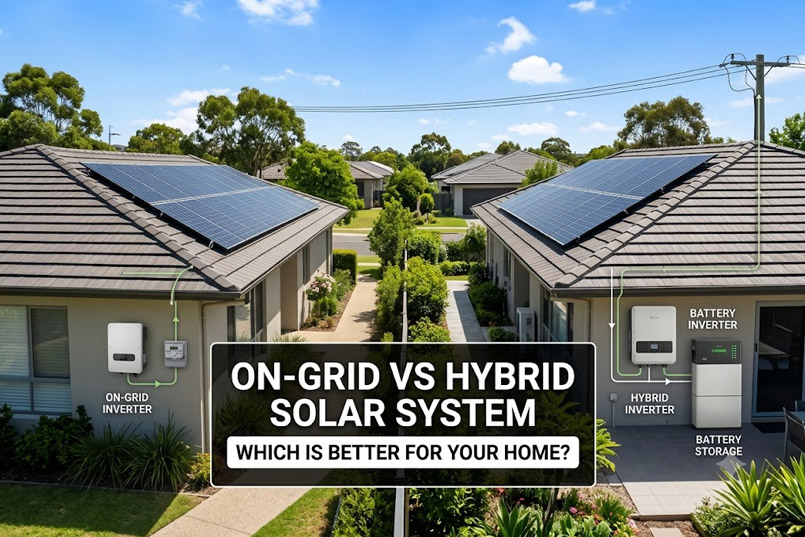
On-Grid vs Hybrid Solar System: Which Is Better for Your Home?
If you are planning to install solar panels at home, one of the most important decisions is choosing the right type of solar system.
Two popular options are on-grid solar systems and hybrid solar systems.
Both can reduce your dependence on grid electricity and help lower your electricity bills. However, they work differently when it comes to battery storage, backup power, initial investment and energy management.
So, which is better: on-grid vs hybrid solar?
The answer depends on your electricity consumption, budget, power-cut frequency and whether you need battery backup.
What Is an On-Grid Solar System?
An on-grid solar system is connected to both your home and the electricity grid.
During the day, your solar panels generate electricity. Your home can use that solar power, reducing the amount of electricity you need to purchase from the grid.
If your system generates more electricity than your home is using, excess electricity may be exported to the grid under the applicable net-metering or other utility arrangements.
An on-grid system typically does not require batteries.
Main Advantages of On-Grid Solar
- Lower initial cost
- No battery required
- Reduced electricity bills
- Simple system configuration
- Lower maintenance compared with battery-based systems
- Can be suitable for homes with reliable grid electricity
Main Limitation
A standard on-grid solar system generally does not provide backup electricity during a grid power outage.
This is an important point that homeowners should understand before choosing an on-grid system.
What Is a Hybrid Solar System?
A hybrid solar system combines solar panels, the electricity grid and battery storage.
Solar electricity can be used to power your home, while excess energy can be stored in batteries depending on the system configuration.
During a grid outage, the battery can provide backup power to selected loads or the home, depending on the system design.
Main Advantages of Hybrid Solar
- Solar electricity generation
- Battery storage
- Backup during power cuts
- Reduced grid dependence
- Better energy management
- Can store excess solar generation
Main Limitation
Hybrid systems generally have a higher upfront cost because they include battery storage and additional equipment.
On-Grid vs Hybrid Solar: Quick Comparison
| Feature | On-Grid Solar | Hybrid Solar |
|---|---|---|
| Grid connection | ✅ Yes | ✅ Yes |
| Solar panels | ✅ Yes | ✅ Yes |
| Battery | Usually ❌ | ✅ Yes |
| Backup during power cuts | Usually ❌ | ✅ Yes |
| Lower initial cost | ✅ Yes | ❌ |
| Electricity bill reduction | ✅ Yes | ✅ Yes |
| Battery replacement | ❌ | Eventually |
| Energy storage | ❌ | ✅ |
| Best for | Bill savings | Savings + backup |
On-Grid vs Hybrid Solar: Cost
One of the biggest differences between the two systems is the initial investment.
On-Grid Solar Cost
An on-grid system generally costs less because it does not require a battery bank.
For homeowners whose primary objective is to reduce their electricity bill, this can make an on-grid system an attractive option.
Hybrid Solar Cost
A hybrid solar system usually costs more because it includes batteries and a hybrid inverter.
The final price depends on:
- Solar system capacity
- Battery capacity
- Battery technology
- Inverter
- Solar panels
- Mounting structure
- Installation requirements
- Backup-load requirements
If you need backup power, the additional investment may be worthwhile.
Which System Gives Better Electricity Bill Savings?
Both systems can reduce electricity bills.
However, your actual savings depend on how much solar electricity your home consumes, how much energy is exported or stored, and the applicable electricity and net-metering rules.
An on-grid system is particularly attractive when your primary objective is maximum bill reduction with a lower upfront investment.
A hybrid system provides additional flexibility because solar energy can also be stored in batteries.
Which System Works During a Power Cut?
This is one of the biggest differences between the two options.
On-Grid Solar During a Power Cut
A standard on-grid system generally shuts down when the grid goes off.
This is a safety feature designed to prevent electricity from being fed into a grid that utility workers may be repairing.
Therefore, simply having solar panels does not necessarily mean your home will have electricity during a power cut.
Hybrid Solar During a Power Cut
A properly configured hybrid system can use stored battery energy to provide backup power.
The amount of backup available depends on your battery capacity and which appliances are connected to the backup circuit.
For example, homeowners may prioritize:
- Lights
- Fans
- Wi-Fi routers
- Refrigerators
- Computers
- Security systems
High-power appliances may require a larger battery and inverter capacity.
Hybrid Solar System for Home: Who Should Consider It?
A hybrid solar system may be suitable for homeowners who experience frequent power cuts or want greater energy independence.
It can be especially useful if you want solar energy to serve two purposes:
Reduce electricity bills + provide backup power.
However, battery storage adds cost, maintenance considerations and eventual replacement expenses.
On-Grid Solar System for Home: Who Should Consider It?
An on-grid system may be a better choice if:
- Your area has reliable grid electricity
- Your main goal is reducing electricity bills
- You want a lower initial investment
- You don’t require battery backup
- You have sufficient rooftop space
- You are comfortable relying on the grid when solar isn’t available
For many homeowners, this is the simplest way to start using rooftop solar.
Battery Replacement: An Important Hybrid Cost
Batteries don’t last forever.
The lifespan of a battery depends on factors such as:
- Battery chemistry
- Depth of discharge
- Charging and discharging cycles
- Temperature
- Usage
- Maintenance
- Manufacturer specifications
Therefore, when calculating the long-term cost of a hybrid solar system, don’t consider only the initial purchase price.
You should also consider the future cost of battery replacement.
Which Is More Reliable?
Reliability depends on what you mean by “reliable.”
If your priority is reliable grid-connected solar generation and lower system complexity, an on-grid system can be a good option.
If your priority is electricity availability during power cuts, a properly designed hybrid system has a significant advantage because it can use battery storage for backup.
Which Is Better for Your Home?
There is no single answer for every household.
Choose On-Grid Solar If:
You mainly want to:
- Reduce your electricity bill
- Lower your initial investment
- Avoid battery replacement
- Use the grid when solar power is unavailable
Choose Hybrid Solar If:
You want to:
- Reduce your electricity bill
- Have backup power
- Store solar energy
- Reduce dependence on the grid
- Maintain essential appliances during power cuts
On-Grid vs Hybrid Solar: Which Has Better ROI?
Return on investment depends on the system cost, electricity consumption, solar generation, electricity tariff, battery cost and applicable regulations.
On-grid systems can have a simpler financial calculation because there is no battery replacement cost.
Hybrid systems can provide additional value through backup power, but the higher initial investment and future battery replacement should be included in the calculation.
The “better” system therefore depends on whether you value maximum financial savings or financial savings plus backup capability.
What Size Solar System Should You Choose?
Choosing between on-grid and hybrid is only one part of the decision.
You also need to select the correct system capacity.
Common residential options include:
- 2kW solar systems
- 3kW solar systems
- 5kW solar systems
- 10kW solar systems and larger systems for higher consumption
Your monthly electricity bills are one of the best starting points for determining the appropriate capacity.
For example, homeowners considering a 3kW installation can evaluate their requirements against the expected 3kW solar system price in Punjab before making a decision.
Questions to Ask Before Installing Solar
Before choosing an installer, ask:
- Is the proposed system on-grid or hybrid?
- What solar panels are included?
- Which inverter will be installed?
- If hybrid, what battery capacity is included?
- What appliances will receive backup power?
- What is the expected annual solar generation?
- What warranties are included?
- What installation work is included?
- What happens during a grid outage?
- What will the estimated electricity savings be?
Getting clear answers can help you compare systems more accurately.
On-Grid vs Hybrid Solar: Final Verdict
If your main goal is reducing your electricity bill at the lowest initial investment, an on-grid solar system may be the better choice.
If you want solar savings plus battery backup during power cuts, a hybrid solar system may be worth the additional investment.
The right system depends on your home’s electricity consumption, rooftop conditions, budget and backup requirements.
You don’t have to make the decision based on a generic recommendation.
Not sure which solar system is right for your home? Contact A.P. Tech Solar for a site assessment and personalized recommendation.
A professional assessment can help determine whether an on-grid or hybrid solar system is the better fit for your home and electricity requirements.