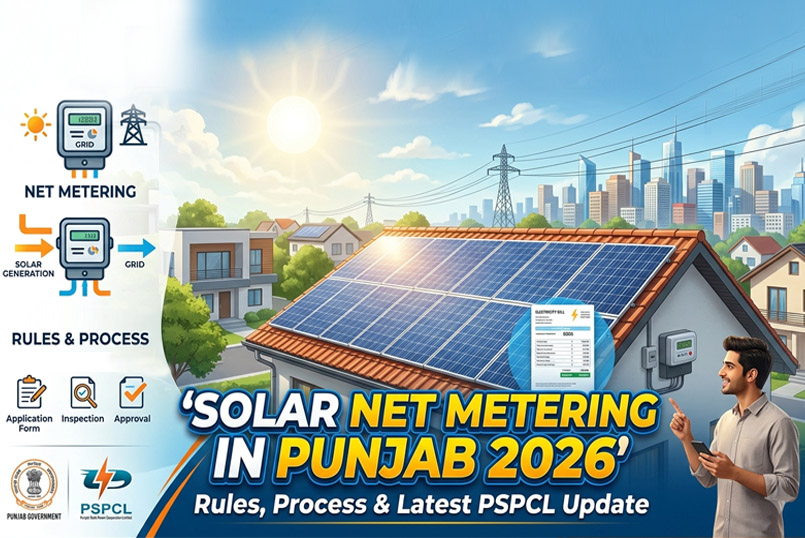
Solar Net Metering in Punjab 2026: Rules, Process & Latest PSPCL Update
If you are planning to install a rooftop solar system in Punjab, understanding solar net metering is just as important as choosing the right solar panels and inverter.
Net metering allows eligible rooftop-solar consumers to use the electricity generated by their solar system and account for electricity exchanged with the grid through the applicable metering and settlement mechanism.
For homeowners and businesses considering rooftop solar in cities such as Patiala, Ludhiana, Mohali, Chandigarh and other parts of Punjab, knowing the application process and current PSPCL requirements can make the installation process much easier.
There has also been a recent PSPCL update in August 2026 concerning the submission of a separate Net Metering Agreement for rooftop-solar applicants.
What Is Solar Net Metering?
Solar net metering is a mechanism used with grid-connected rooftop solar systems.
During the day, your solar panels generate electricity. Your property consumes this electricity first.
If your solar system produces more electricity than your property is using at that moment, the surplus can be exported to the electricity grid, subject to the applicable Punjab regulations and metering arrangement.
When your solar generation is lower than your consumption, electricity can be imported from the grid.
This allows a rooftop solar system to work together with your existing electricity connection rather than operating completely separately from the grid.
Latest PSPCL Solar Net Metering Update in 2026
One of the latest developments for Punjab rooftop-solar consumers came from PSPCL on 31 August 2026.
PSPCL issued Commercial Circular No. 35/2026 concerning relaxation in the submission of a separate Net Metering Agreement for prosumers applying for rooftop solar connections under the PSERC Grid Interactive Rooftop Solar PV Systems Regulations, 2021.
This is important because documentation and application procedures can affect how smoothly a rooftop solar installation moves from application to commissioning.
Important: Requirements can vary according to consumer category, system configuration and applicable regulations. Consumers should confirm the current procedure with PSPCL or their authorised solar installer before submitting an application.
How Does Net Metering Work?
Your solar energy can be used in three ways:
1. Used by your home/business
Solar electricity is consumed by appliances and equipment operating on your premises.
2. Surplus exported to the grid
If generation exceeds your immediate consumption, surplus electricity may flow to the grid according to the applicable metering arrangement.
3. Electricity imported from the grid
When solar generation is insufficient, such as at night, electricity can be supplied by the grid.
The actual billing and settlement depend on the applicable regulations and metering arrangement.
What Is the Difference Between Net Metering and Net Billing?
These terms are often confused.
Net Metering
The system accounts for electricity imported from and exported to the grid according to the applicable net-metering framework.
Net Billing
Under net billing, electricity imported from PSPCL is billed at the applicable retail tariff, while electricity exported to PSPCL is settled at the applicable feed-in tariff.
PSPCL documentation describes this distinction for rooftop-solar arrangements.
For FY 2026–27, PSPCL’s Commercial Circular No. 14/2026 states a ₹2.97/kWh feed-in tariff for net-billing and gross-metering arrangements under the relevant rooftop-solar regulations, applicable from 1 April 2026 to 31 March 2027.
Because these rules can change, your installer should evaluate the applicable arrangement for your specific connection before finalising the project.
Who Should Consider Rooftop Solar in Punjab?
Solar can be attractive for:
Homeowners
Especially households with relatively high electricity consumption and suitable rooftop space.
Shops & Offices
Businesses operating during daylight hours can directly consume a significant portion of solar generation.
Factories
Industrial consumers with large daytime electricity consumption may benefit from a properly designed solar system.
Schools & Institutions
Solar can help institutions reduce recurring electricity expenditure while supporting their sustainability goals.
How Much Solar Capacity Do You Need?
There is no single system size that is suitable for every property.
For example:
| Solar System | Typical Application |
|---|---|
| 2–3 kW | Smaller homes |
| 5 kW | Medium/high-consumption homes |
| 10 kW | Large homes, offices & small businesses |
| 20–50 kW | Commercial properties |
| 50 kW+ | Larger commercial/industrial applications |
The correct size should be calculated from electricity consumption, roof availability, sanctioned load and project objectives.
Is Solar Subsidy Available in Punjab?
Residential consumers may be eligible for Central Financial Assistance under the applicable PM Surya Ghar framework, subject to current scheme rules and eligibility.
MNRE states that residential consumers can apply through the national rooftop-solar portal or applicable DISCOM mechanisms, with CFA transferred after successful installation and DISCOM verification under the relevant mechanism.
Important: Do not assume that every commercial or industrial solar installation qualifies for the same residential subsidy.
For a business, factory or industrial project, the economics should instead be evaluated using the applicable tariff, consumption profile, system cost, savings and project-specific regulations.
Solar Net Metering Process in Punjab
The general process can involve the following stages:
Step 1: Electricity Bill Assessment
Your solar installer reviews your recent electricity bills and consumption pattern.
Step 2: Site Survey
The rooftop is inspected for available space, orientation, shading and structural considerations.
Step 3: System Design
The appropriate solar capacity, panels, inverter, mounting structure and protection equipment are selected.
Step 4: Application
The rooftop-solar application is submitted through the applicable PSPCL/national process depending on the consumer category and subsidy route.
PSPCL currently provides a dedicated rooftop-solar service and notes that subsidy applications are handled through the PM Surya Ghar National Portal.
Step 5: Installation
After the applicable approvals and project requirements are completed, the solar system is installed.
Step 6: Inspection & Metering
The system is inspected and the applicable metering/commissioning process is completed.
Step 7: Solar Generation Begins
Once commissioned, the system can begin generating electricity and the applicable grid settlement mechanism comes into effect.
Why Choose A.P. Tech Solar?
At A.P. Tech Solar, we help homeowners and businesses evaluate rooftop solar based on their actual electricity requirements and property conditions.
Our approach focuses on:
- Proper site assessment
- Suitable system sizing
- Quality solar equipment
- Professional installation
- Assistance with the applicable solar application process
- Reliable after-sales support
If you are planning rooftop solar in Patiala or elsewhere in Punjab, contact A.P. Tech Solar for a site assessment and customised solar quotation.
Ready to reduce your electricity costs with solar? Contact A.P. Tech Solar today.
Frequently Asked Questions
Is net metering available in Punjab?
Punjab has a regulatory framework for grid-interactive rooftop solar systems, with PSPCL handling applicable rooftop-solar processes for its consumers.
What is the latest PSPCL net-metering update?
On 31 August 2026, PSPCL issued a circular regarding relaxation in the submission of a separate Net Metering Agreement for rooftop-solar applicants.
Can I install solar without net metering?
A solar system can technically be designed under different configurations, but the appropriate grid connection and metering arrangement depends on the system type, consumer category and applicable regulations.
Is solar subsidy available for businesses?
Residential subsidy schemes should not automatically be assumed to apply to commercial or industrial consumers. Eligibility should be checked under the applicable current scheme and consumer category.
How much can I save with rooftop solar?
Savings depend on your electricity consumption, solar capacity, generation, electricity tariff, system cost and applicable grid-settlement mechanism.